
At a glance
-
Prostate Specific Antigen (PSA) is a protein made by the prostate that can be measured in the blood. PSA is linked to prostate inflammation, enlargement, and, in some cases, cancer risk. Results also depend on age and can shift temporarily because of medications, vigorous exercise, urinary tract infection, and other factors.
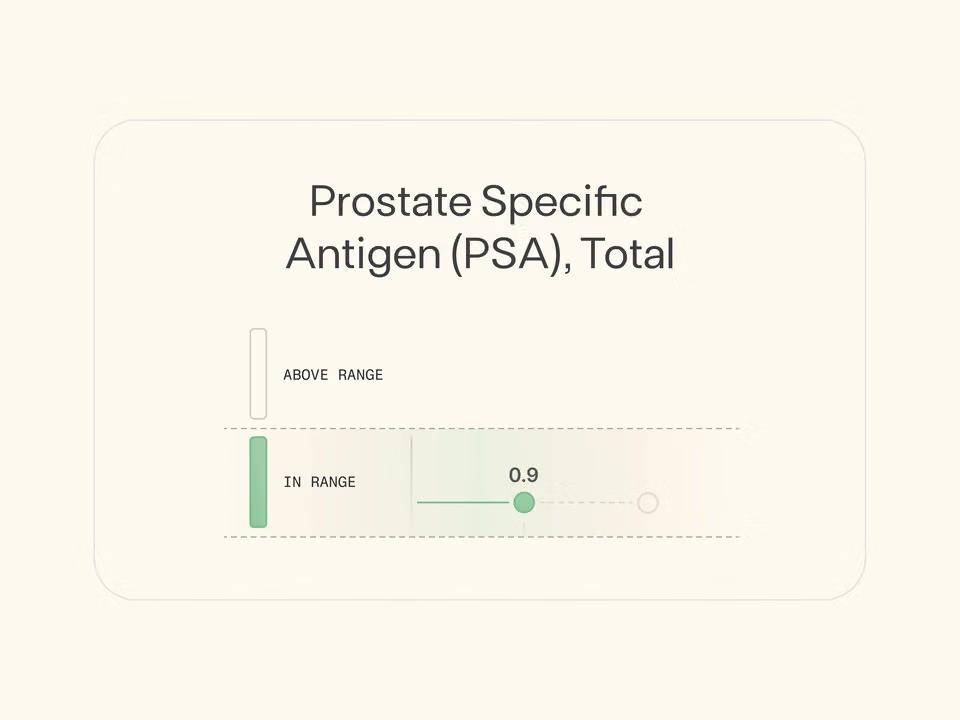
Function's 160+ lab tests include PSA—Total, Free, and % Free—in the Annual Test. Your Clinician Notes flag results outside the reference range and explain factors that might be contributing to it. The Annual MRI scans for signs of prostate cancer, prostate enlargement, prostate inflammation, and other potential conditions.
What a PSA result measures
A PSA test measures the concentration of Prostate Specific Antigen in your blood. PSA is prostate-specific, not cancer-specific. An elevated PSA level may point to conditions such as benign prostatic hyperplasia (BPH, or prostate enlargement) or prostatitis (inflammation or infection). While an elevated level might also signal cancer risk, this is not always the case. In some cases, cancer can be present even when a PSA level appears within the typical reference range. That's why context and clinical interpretation matter.
What can influence your PSA
PSA levels generally rise with age, and other variables shape individual results.
Age
The following thresholds are commonly cited as reference points, though they aren't universal definitions of "normal" and don't diagnose or rule out any condition on their own:
- 40–49 years: ≤2.5 ng/mL
- 50–59 years: ≤3.5 ng/mL
- 60–69 years: ≤4.5 ng/mL
- 70–79 years: ≤6.5 ng/mL
Body weight
Men with a higher body mass index (BMI) tend to have somewhat lower PSA levels, possibly due to dilution across a larger blood volume. However, this association isn't established enough yet to support routine BMI-based adjustments.
Medications
Common medications may influence PSA levels. Statins (such as atorvastatin) have been associated with slightly lower PSA levels in some men. Finasteride—used for conditions such as BPH and male pattern hair loss—works by reducing dihydrotestosterone (DHT) production, a hormone involved in prostate growth, and can lower PSA as a result. Let your doctor know about everything you're taking.
Ejaculation
PSA can rise temporarily after ejaculation and return to baseline within 24–48 hours. Consider abstaining for at least 48 hours before a PSA test.
Infection or inflammation
Prostatitis or a urinary tract infection can increase PSA levels and may persist for several weeks after the infection clears. In these situations, your doctor may suggest waiting some time before testing or re-testing PSA.
Who should test, and how often
The American Cancer Society recommends that men at average risk should discuss prostate cancer screening with their doctor starting at age 50. That conversation should start earlier—around 40–45—if you're Black or have a first-degree relative (father or brother) diagnosed at an early age.
PSA in context
Beyond any single reading, access to more comprehensive data and tracking PSA over time can help you establish a baseline. This is why Function helps you test it every year. Function includes PSA—Total, Free, and % Free—in the Annual Test, and Clinician Notes flag out-of-range results with insights from a licensed clinician.
To learn even more about your prostate health, you may think about an Annual MRI, which can look for signs of prostate cancer, prostate enlargement, prostate inflammation, and hundreds of other conditions. Labs look at signals in your blood. MRI shows what's happening in your body. Together, you get your baseline that you can over time.
End notes
Cleveland Clinic. What Does an Elevated PSA Level Mean? Cleveland Clinic. 2024. Accessed August 24, 2026. https://my.clevelandclinic.org/health/symptoms/15282-elevated-psa-prostate-specific-antigen-level
Cleveland Clinic. Why Do I Need a PSA Test? Cleveland Clinic. March 21, 2024. Accessed August 24, 2026. https://my.clevelandclinic.org/health/diagnostics/24615-psa-test
Prostate-Specific Antigen (PSA) Test - NCI. December 12, 2024. Accessed April 17, 2026. https://www.cancer.gov/types/prostate/psa-fact-sheet
David MK, Leslie SW. Prostate specific antigen (PSA). PubMed. Published 2024. https://www.ncbi.nlm.nih.gov/books/NBK557495/
Harrison S, Tilling K, Turner EL, et al. Systematic review and meta-analysis of the associations between body mass index, prostate cancer, advanced prostate cancer, and prostate-specific antigen. Cancer Causes Control. 2020;31(5):431-449. doi:10.1007/s10552-020-01291-3
David MK, Leslie SW. Prostate-Specific Antigen (PSA). PubMed. 2024. Accessed August 24, 2026. https://www.ncbi.nlm.nih.gov/books/NBK557495/
Zito PM, Bistas KG, Syed K. Finasteride. PubMed. 2021. Accessed August 25, 2026. https://www.ncbi.nlm.nih.gov/books/NBK513329/
Cleveland Clinic. DHT (dihydrotestosterone): What it is, side effects & levels. Cleveland Clinic. December 20, 2022. Accessed August 25, 2026. https://my.clevelandclinic.org/health/articles/24555-dht-dihydrotestosterone
Zhou Z, Cui Y, Wu J, Jin H. Efficacy and safety of dutasteride compared with finasteride in treating males with benign prostatic hyperplasia: A meta-analysis of randomized controlled trials. Exp Ther Med. 2020;20(2):1566-1574. doi:10.3892/etm.2020.8851
Han B, Moon KH. Beyond the Number: Interpreting Prostate-Specific Antigen Elevation in the Context of Prostate Inflammation. Urogenit Tract Infect. 2025;20(3):132-143. doi:10.14777/uti.2550032016
American Cancer Society. American cancer society recommendations for prostate cancer early detection. www.cancer.org. November 22, 2023. Accessed August 25, 2026. https://www.cancer.org/cancer/types/prostate-cancer/detection-diagnosis-staging/acs-recommendations.html