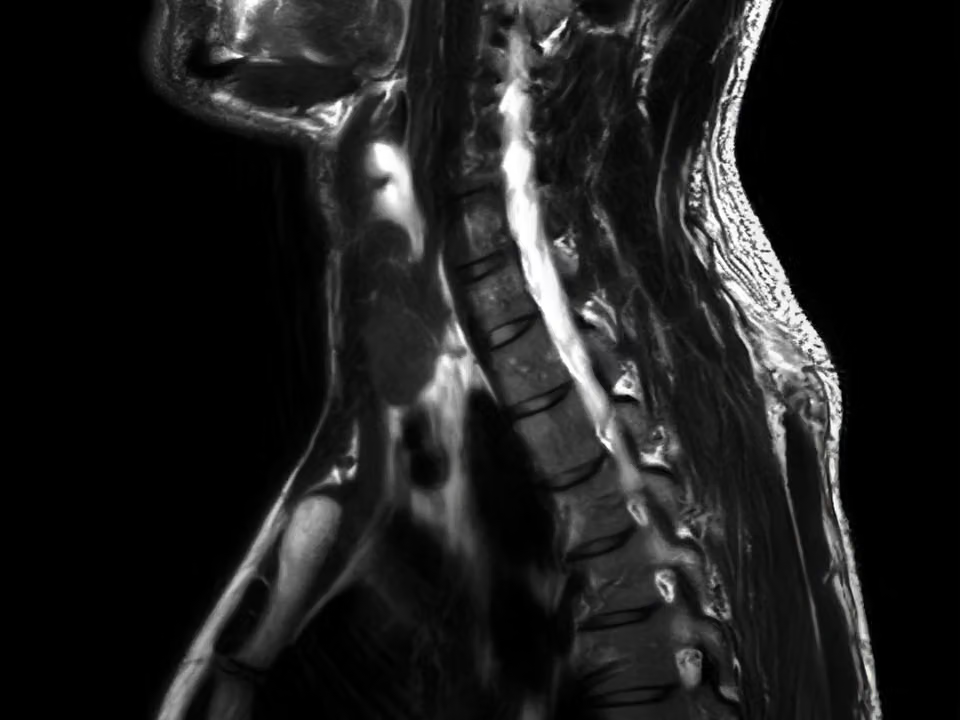

At a glance
-
Function member: Ian, 36
-
Function focus: Heart
-
Biomarker imbalances: Heart
-
Heart: Above range: LDL Medium, LDL Small, LDL Particle Number, LDL-Cholesterol, Lipoprotein (a), Non-HDL Cholesterol, Total Cholesterol
-
Heart: Below range: HDL Large
-
Heart: Narrower than optimal: LDL Peak Size

Overlooked symptoms
As a 36-year-old CEO, Ian followed a structured, active, and health-conscious routine. He’s an early riser who wears his smart watch religiously and rarely misses a workout.
So when his watch detected an uptick in his resting heart rate from the low 50s to the mid 70s beats per minute—and fatigue started affecting his productivity—he noticed.
His primary care provider dismissed it. His resting heart rate was still “normal.” His symptoms were probably “just a virus”. And he was “too young” for any serious heart issues.
But the symptoms worsened. An eventual echocardiogram revealed the truth: an infection on his mitral valve, explaining the elevated heart rate, fatigue, and muscle aches.
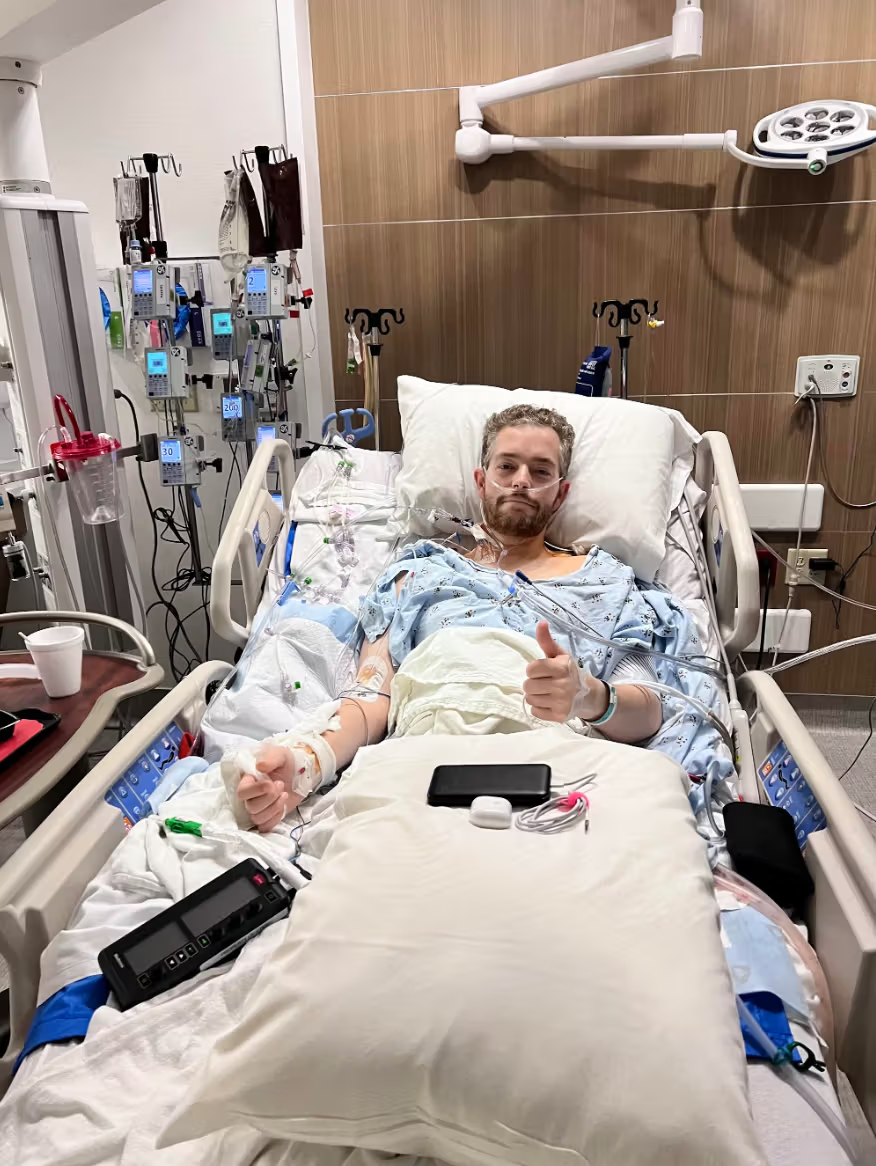
By then, it was urgent. Ian needed open heart surgery and three weeks in the hospital.
If they’d found it earlier, I could’ve maybe treated it with just antibiotics and been out of the hospital in two days. I maybe wouldn’t have needed open heart surgery.
That experience changed everything.
Ian’s post-surgery care included three months of home health monitoring, including blood draws. A few months later, he turned to Function to continue monitoring his recovery and to manage his heart health on his terms.
Taking control
The main concern for the first few months after surgery was getting a baseline for heart biomarkers, knowing they would be out of range.
My thinking was, if I establish a baseline with Function, then I'd be in a much better position to get people’s attention if something arises.
Ian’s first Function test confirmed that recovery was still in motion.
Nearly half of his heart biomarkers were out of range, including above-range high-sensitivity c-reactive protein (hs-CRP), which could suggest an increase in inflammation linked to heart disease, and an above-range LDL particle number, which can increase cardiovascular risk. Ian’s lipoprotein (a) level was also slightly above the normal limit, which is associated with coronary heart disease risk.
With his Function results, Ian had visibility into his health at that moment, a plan to continue his recovery, and a platform to track his progress with confidence.
He also started to understand how small inputs could drive serious impact.
Though Ian’s sodium level was just one point under the typical reference range—which may not be clinically significant—his Function clinician notes took his surgery into account and highlighted the importance of electrolytes’ role in maintaining fluid balance for cardiovascular health.
I didn’t know this beforehand, but electrolytes are critical to maintaining regular heart rhythms. It became critical that I monitor those things going forward and Function allowed me to do that—in a way that was more comprehensive than what I get (from an average physical), and way easier.
With his data in hand, Ian made targeted shifts to drive long-term heart health:
- Prioritized adequate electrolyte levels and hydration.
- Refined his diet.
- Focused on muscle gain.
Post-surgery, Function helped him rebuild with precision.

The impact
Today, Ian tracks key biomarkers through Function—each one helping him catch early changes before they become serious.
While he's still in the recovery window, he’s already feeling a difference.
I actually think I’m healthier than I’ve ever been before. I feel more confident about how I feel…and I’ve got the data to back that up.
Function didn’t just help Ian monitor his recovery—it gave him a precise, personal benchmark for health. Not just “average.” Not just “fine.” Buthis baseline, tracked over time and used to inform decisions about his health.
The ability to track and tweak what matters has shifted how he shows up every day.
I’ve changed a little bit of my daily routine. I get an earlier start, I have more energy. As I’ve dialed in some of these health factors, it’s unlocked more time and more productivity.
The power of ownership
For Ian, owning his health comes down to one thing: knowing where he stands—and how things are shifting over time.
It’s really about establishing your own personal baseline. You can’t trust that the professionals around you know that. They’re looking at national or regional averages—maybe. You're responsible for your own health.
The benefit of owning his health and knowing how his health is trending? Peace of mind.
Just being able to enjoy my routine—without pain, concern, or worry. That alone is huge. Not having the mental load of what's coming in the future… that’s a big weight off my shoulders.
If Function didn’t exist
Before discovering Function, Ian followed the traditional route: multiple appointments, limited follow-up testing, and a system built to react—not prevent.
Had he not joined Function, he likely wouldn’t have been able to pick up where his three months of post-surgery monitoring left off—leaving him with less ongoing data to empower daily decisions.
I think you can own your health without excessive or luxurious spending. Function made that possible.
Function gave him something the system didn’t: expansive data. A way to track what matters. And a way to manage his health outside the doctor’s office.
The lesson
One of Ian’s biggest takeaways? Age doesn’t protect you. Awareness does.
Just because everyone around you says you’re young and healthy—that may not be true.
Ian was 36 when he underwent open heart surgery. The head of infectious disease at his hospital believes his issues likely stemmed from an infection after a routine dental cleaning.
If a 36-year-old can end up with a heart valve replacement from a routine dental cleaning—then everyone needs to be aware of what’s happening with their health.
That experience changed how Ian thinks about risk and personal responsibility.
Don’t assume you’ll just overcome whatever you’re feeling today. You want a baseline. You want to know your numbers.
And his advice to others:
Just get started. At the very least, you’ll learn everything’s fine. Find out where your health sits—you’ll probably be surprised. I was.
End notes
Cleveland Clinic. Endocarditis: Symptoms, Causes, Tests and Treatment. Cleveland Clinic. Published May 12, 2025. https://my.clevelandclinic.org/health/diseases/16957-endocarditis#symptoms-and-causes
Cleveland Clinic. Endocarditis. Cleveland Clinic. Published May 12, 2022. https://my.clevelandclinic.org/health/diseases/16957-endocarditis
Hye Sun Lee, Lee JH. Early elevation of high-sensitivity C-reactive protein as a predictor for cardiovascular disease incidence and all-cause mortality: a landmark analysis. Scientific reports. 2023;13(1). doi: https://doi.org/10.1038/s41598-023-41081-w
Devaraj S, Semaan JR, Jialal I. Biochemistry, Apolipoprotein B. PubMed. Published 2020. https://www.ncbi.nlm.nih.gov/books/NBK538139/
Cleveland Clinic. Electrolytes: Types, Purpose and Normal Levels. Cleveland Clinic. Published 2021. https://my.clevelandclinic.org/health/diagnostics/21790-electrolytes
Dmitrieva NI, Liu D, Wu CO, Boehm M. Middle age serum sodium levels in the upper part of normal range and risk of heart failure. European Heart Journal. 2022;43(35). doi: https://doi.org/10.1093/eurheartj/ehac138
Monnard CR, Grasser EK. Water ingestion decreases cardiac workload time-dependent in healthy adults with no effect of gender. Scientific Reports. 2017;7(1):7939. doi: https://doi.org/10.1038/s41598-017-08446-4
Lichtenstein AH, Appel LJ, Vadiveloo M, et al. 2021 Dietary Guidance to Improve Cardiovascular Health: A Scientific Statement From the American Heart Association. Circulation. 2021;144(23):472-487. doi: https://doi.org/10.1161/cir.0000000000001031
Qiu S, Wang Q, Chen W, et al. Cumulative Muscle Strength and Risk of Cardiovascular Disease and All-cause mortality: A Prospective Cohort Study. Archives of Medical Research. 2023;54(3):261-269. doi: https://doi.org/10.1016/j.arcmed.2023.01.002