
At a glance
-
The Annual MRI includes images of your abdomen and pelvis, so a short fast is part of standard prep: no food for 6 hours before your appointment and limited fluids for about 2 hours before. That’s not because the Annual MRI uses contrast dye or sedation—it doesn’t. A full stomach or active digestion can obscure the images in this region.
How MRI works
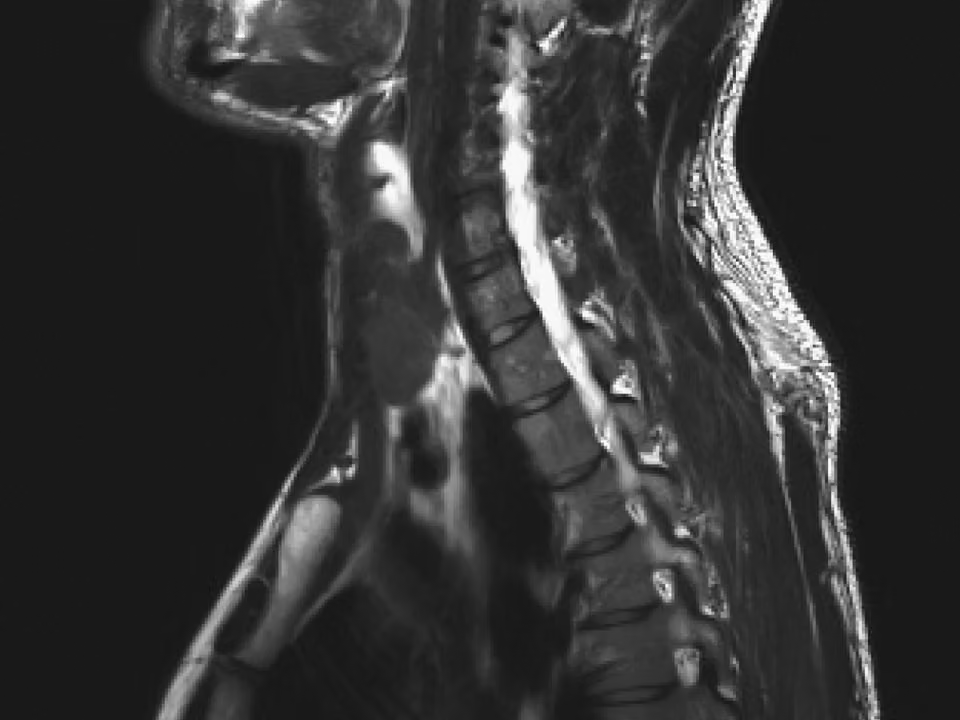
Magnetic resonance imaging (MRI) uses a strong magnetic field and radio waves to produce detailed images inside your body. Unlike x-ray or CT, it doesn’t use ionizing radiation.
A magnetic field temporarily aligns hydrogen atoms in the water molecules throughout your body. A radio wave pulse then knocks those atoms out of alignment. As they return to place, they release energy that sensors in the MRI machine detect. A computer translates those signals into images.
MRI is especially useful for imaging soft tissue. Organs like the brain, liver, pancreas, kidneys, and prostate can appear in more detail that other imaging methods can’t always match. That’s what makes MRI helpful for looking for signs of hundreds of potential conditions in different parts of your body.
Why fasting matters for the Annual MRI
Fasting before an MRI usually comes down to one of three factors:
- A contrast agent injected into a vein
- Sedation
- Scanning regions near the digestive tract, where a full stomach or active digestion can obscure the images.
The Annual MRI doesn’t use contrast or sedation. But it does scan the abdomen and pelvis, and that’s where fasting matters. Eating and drinking trigger peristalsis—the muscle contractions that move food and fluids through your gut. That movement, along with a full stomach or trapped gas, can obscure anatomy and reduce image quality.
How to prepare for your Annual MRI
- No food for 6 hours before your appointment. An empty stomach helps ensure better image quality.
- Limit fluid intake for about 2 hours before your appointment. This is to avoid needing the restroom during your appointment.
- The day before, we recommend avoiding fried or greasy foods and gas-producing foods—think soda, seltzer, beans, broccoli, and cabbage. These can cause bloating that affects imaging.
You’ll receive specific instructions from Function ahead of your appointment.
Compare that to MRIs that use contrast agents or sedation, which can call for longer fasting windows and extra precautions beforehand. The purpose of the Annual MRI’s prep is to keep the pictures of your body as clear as possible.
What the Annual MRI looks for
In about 22 minutes, the Annual MRI scans your head, neck, abdomen, and pelvis. It looks for signs of hundreds of potential conditions, including signs of cancer in the brain, thyroid, liver, gallbladder, pancreas, spleen, kidneys, adrenal glands, bladder, ovaries, uterus, and prostate, plus signs of prior stroke, fatty liver, sinus inflammation, uterine fibroids, and abdominal aortic aneurysm.
Function members get member pricing on the Annual MRI ($899), alongside 160+ lab tests every year.
End notes
Center for Devices and Radiological Health. Benefits and Risks. FDA. Published online September 2, 2019. Accessed April 29, 2026. https://www.fda.gov/radiation-emitting-products/mri-magnetic-resonance-imaging/benefits-and-risks
How Does an MRI Machine Work? | NIST. 2025. Accessed August 19, 2026. https://www.nist.gov/how-do-you-measure-it/how-does-mri-machine-work
Pai A, Shetty R, Hodis B, Chowdhury YS. Magnetic Resonance Imaging Physics. In: StatPearls. StatPearls Publishing; 2026. Accessed April 29, 2026. http://www.ncbi.nlm.nih.gov/books/NBK564320/
Ibrahim MA, Hazhirkarzar B, Dublin AB. Gadolinium Magnetic Resonance Imaging. In: StatPearls. StatPearls Publishing; 2026. Accessed April 29, 2026. http://www.ncbi.nlm.nih.gov/books/NBK482487/
Patel KS, Thavamani A. Physiology, Peristalsis. In: StatPearls. StatPearls Publishing; 2026. Accessed April 29, 2026. http://www.ncbi.nlm.nih.gov/books/NBK556137/
Schrauben EM, Lima da Cruz G, Roy CW, Küstner T. Motion Mitigation Techniques for Abdominal and Cardiac MR Imaging. Journal of Magnetic Resonance Imaging. 2025;63(4):917-937. doi:10.1002/jmri.70209
American Society of Anesthesiologists. Practice Guidelines for Preoperative Fasting and the Use of Pharmacologic Agents to Reduce the Risk of Pulmonary Aspiration: Application to Healthy Patients Undergoing Elective Procedures. Anesthesiology. 2017;126(3):376-393. doi:10.1097/ALN.0000000000001452
Stanford Health Care. What to Expect Before an MRI. Stanford Health Care; 2026. Accessed August 19, 2026. https://stanfordhealthcare.org/medical-tests/m/mri/what-to-expect/before.html