At a glance
-
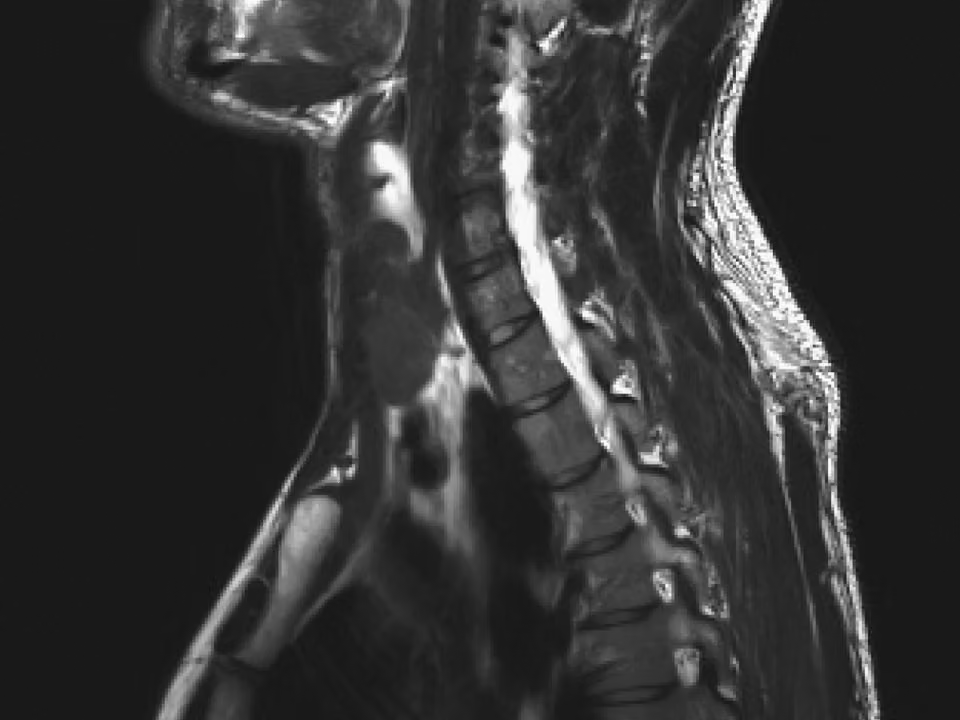
Function's MRI packages are contrast-free by design—there's no dye, no ionizing radiation, and no injections—but they can still look for signs of hundreds of conditions, including signs of cancer.
Get an MRI, and you might expect a needle, a dye injection, or exposure to ionizing, or potentially harmful, radiation. With Function, you get none of that. Function's MRIs use strong magnets and radio waves to capture detailed images of your body—no ionizing radiation, contrast dye, or injections—while still scanning for signs of hundreds of potential conditions, including signs of cancer in the brain, liver, kidneys, and prostate.
What's an MRI, and where does contrast come in?
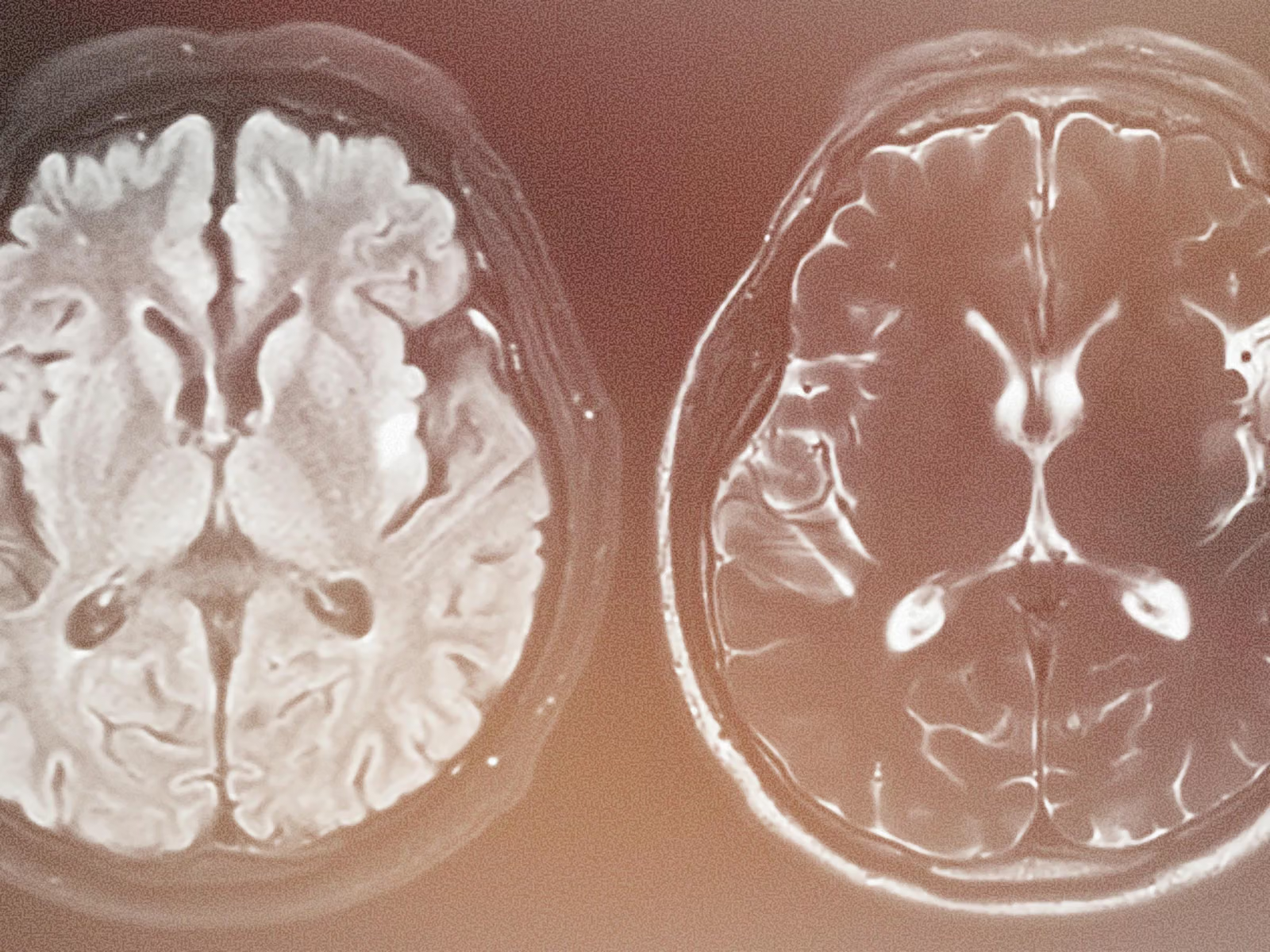
An MRI machine uses a powerful magnet along with radio waves to take detailed pictures of your body. Unlike a computed tomography (CT) scan or an X-ray, MRIs don't use ionizing radiation.
A contrast agent is a substance injected into a vein that makes certain tissues, organs, or blood vessels show up more clearly on an MRI. It's typically used when a clinician needs a closer look at soft tissue or blood vessels, or to understand how a specific area is behaving—for example, characterizing an abnormal region or zooming in on the pituitary gland.
Common types of contrast agents
Radiologists can use different types of MRI contrast agents depending on the clinical situation:
- Gadolinium-based contrast agents (GBCAs). The most widely used type, GBCAs are particularly helpful for getting a detailed look at tumors.
- Iron oxide-based contrast agents. Far less common than gadolinium agents, these are mainly used off-label—often for patients who can't tolerate gadolinium, as well as newer approved uses including brain tumor imaging.
Potential contrast agent side effects
Most people tolerate contrast agents well, and serious reactions are uncommon. But contrast-enhanced MRIs come with different considerations than non-contrast MRIs:
Mild, short-lived reactions
The most common side effects happen during or shortly after the injection and typically resolve on their own. These include pain at the injection site, nausea, headache, a tingling or burning sensation, and dizziness.
Allergic reactions
Uncommon, but possible. Mild reactions (itching, rash, hives) can usually be managed with antihistamines. Severe allergic reactions are rare but can be serious, so any swelling, difficulty breathing, or fainting should be treated as a medical emergency.
Gadolinium retention
Most gadolinium is cleared through the kidneys after the MRI, but small amounts can remain in the body's tissues over time. Retention has not been linked with adverse effects in people with normal kidney function, but people with kidney conditions should discuss this with their healthcare provider.
Nephrogenic systemic fibrosis (NSF)
A rare but serious condition linked to gadolinium exposure in people with significant, pre-existing kidney impairment.
Additional requirements when contrast is used
Beyond the injection itself, an MRI with contrast typically comes with extra steps that a non-contrast MRI doesn't require:
Pre-MRI bloodwork
Because gadolinium is cleared through the kidneys, many facilities require a recent blood test to check kidney function before administering contrast—particularly for anyone with a history of kidney issues or diabetes.
Allergy screening
You'll usually be asked about prior reactions to contrast dye or other allergies before the injection.
A longer procedure
Adding contrast extends the MRI itself, since non-contrast images are typically taken first, followed by additional imaging after the dye is administered.
Function's MRI: Built to skip the contrast dye and ionizing radiation
Function's MRI packages are non-contrast by design. That means:
- No injection: There's no IV line and no dye.
- No harmful radiation: MRIs in general don't use ionizing radiation, and Function's non-contrast approach avoids the injection-related considerations that come with contrast agents entirely.
- Non-invasive imaging: You lie on a table, the table moves into the machine, and the machine does the rest. You can talk to the technologist through an intercom the whole time.
When a doctor might still recommend contrast
Function's non-contrast MRI is a screening tool meant to look for signs of hundreds of conditions, not a diagnostic tool. A doctor will order you a targeted, contrast-enhanced MRI to help answer a specific medical question, investigate a specific symptom, or to learn more about a known finding.
Pair your MRI with 160+ lab tests for a clearer view of your health
Function's 160+ yearly lab tests show what's circulating in your blood and urine—inflammation, heart health, metabolism, nutrients, and more. Function's MRIs* show what's inside your body—organs, tissues, and other changes. That's why Function recommends getting both every year for a clearer picture of your health that you can track over time.
*Available for an additional cost.
End notes
Magnetic Resonance Imaging (MRI). May 22, 2024. Accessed August 26, 2026. https://www.hopkinsmedicine.org/health/treatment-tests-and-therapies/magnetic-resonance-imaging-mri
Ibrahim MA, Hazhirkarzar B, Dublin AB. Gadolinium-Based MRI Contrast Agents. In: StatPearls. StatPearls Publishing; 2023. Accessed August 26, 2026. http://www.ncbi.nlm.nih.gov/books/NBK482487/
Quattrocchi CC, Rovira À, van der Molen AJ, Mallio CA. ESR Essentials: gadolinium-wise MRI—practice recommendations by the European Society for Magnetic Resonance in Medicine and Biology. Eur Radiol. 2025;35(6):3347-3353. doi:10.1007/s00330-024-11214-4
Si G, Du Y, Tang P, et al. Unveiling the next generation of MRI contrast agents: current insights and perspectives on ferumoxytol-enhanced MRI. Natl Sci Rev. 2024;11(5):nwae057. doi:10.1093/nsr/nwae057
Bara MTG, Gallardo-Higueras A, Moreno EM, et al. Hypersensitivity to Gadolinium-Based Contrast Media. Front Allergy. 2022;3:813927. doi:10.3389/falgy.2022.813927
Starekova J, Pirasteh A, Reeder SB. Update on Gadolinium-Based Contrast Agent Safety, From the AJR Special Series on Contrast Media. American Journal of Roentgenology. 2024;223(3):e2330036. doi:10.2214/AJR.23.30036
Weinreb JC, Rodby RA, Yee J, et al. Use of Intravenous Gadolinium-Based Contrast Media in Patients With Kidney Disease: Consensus Statements from the American College of Radiology and the National Kidney Foundation. Kidney Med. 2020;3(1):142-150. doi:10.1016/j.xkme.2020.10.001
Magnetic Resonance Imaging (MRI). Cleveland Clinic Abu Dhabi. Accessed August 26, 2026. https://www.clevelandclinicabudhabi.ae/en/health-library/health-resources/diagnostics-and-testing/magnetic-resonance-imaging
Zhang R, Narra VR, Kansagra AP. Large-Scale Assessment of Scan-Time Variability and Multiple-Procedure Efficiency for Cross-Sectional Neuroradiological Exams in Clinical Practice. J Digit Imaging. 2020;33(1):143-150. doi:10.1007/s10278-019-00252-w